Longline Guidebook
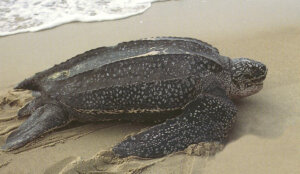
Leatherback turtles are the easiest to identify, as they are the only sea turtle that does not have a hard shell. The shell is black with white spots, and the turtle has 5 to 7 ridges that run down its back. They can grow quite large – up to 1.8 m (6 ft) long and 680 kg (1,500 lbs). The leatherback populations of the Pacific are most at-risk for extinction.
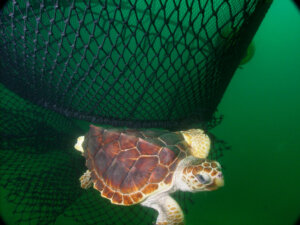
The loggerhead turtle has a wide, blocklike head, and four prefrontal scales (two pairs) between its eyes. Its top shell has 5 central plates going down its back, with 5 lateral plates on each side. They tend to be found in more temperate (subtropical) waters.
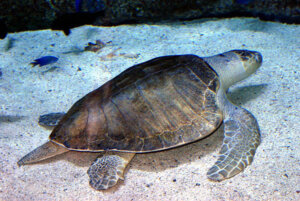
Olive ridley turtles are the smallest and one of the most commonly encountered sea turtles in pelagic, deep-set tuna longline fisheries. Its shell is gray-green, with 5 central plates, and 5 to 9 pairs of lateral plates (the other turtles will never have more than 5). They are more common in tropical waters.
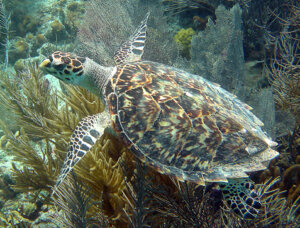
The hawksbill turtle is the most endangered species of sea turtle. It has a sharp, hawklike beak. This is the only turtle whose plates on its top shell overlap, like shingles on a roof. There are 5 central plates, and 4 side pairs.
Green sea turtles have just two prefrontal scales between their eyes, unlike the other turtles that have 4 or 5 scales. Despite their name, green sea turtles’ smooth oval shells are a mix of colors (brown and yellow-green in younger individuals, and darker green in adults). They have 4 lateral plates on their shell. They are usually found in warmer waters.
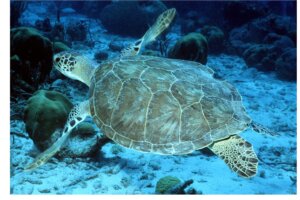
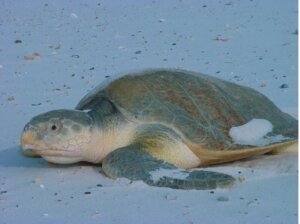
Kemp’s ridley sea turtle is the smallest sea turtle species. Its head is triangular-shaped with a slightly hooked beak. A Kemp’s ridley turtle’s carapace is usually as wide as it is long, with olive-gray color. The front flippers have one claw, while the back flippers may have one or two.