Longline Guidebook
Fish Bait
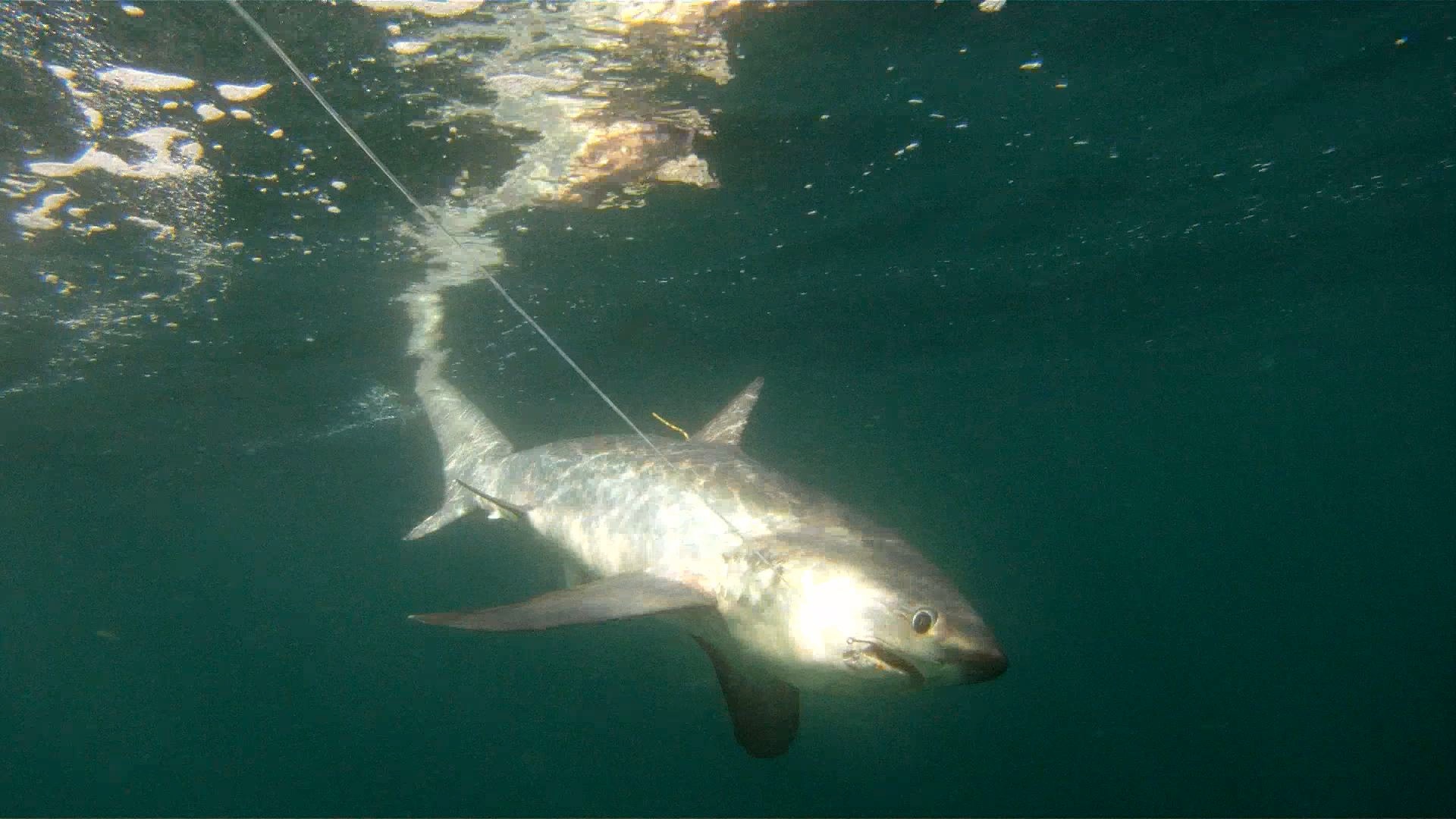
Sharks appear to favor squid over fish as bait, as indicated by both scientific trials and reports from fishers (Gilman et al., 2008). Using fish bait, such as mackerel, can reduce shark catch rates considerably, particularly for blue sharks. Remember that to reduce turtle catch, the use of fish bait is also recommended, so now you have two good reasons to consider using fish instead of squid as your bait.
Circle Hooks
A structured review of scientific research (i.e., meta-analyses of all accumulated research findings) has found that shark catch rates are higher on circle hooks relative to J-shaped hooks, but there are lower at-vessel mortality rates (Gilman et al., 2016; Reinhardt et al., 2017).
This is because animals caught using circle hooks are not hooked as deeply, are less likely to suffer internal injury, and therefore have a higher likelihood of survival. In fisheries where sharks are not retained, there will be a higher shark fishing mortality on circle hooks. However, the benefit of very large reductions in marine turtle catch rates on wide circle hooks may outweigh the tradeoff of increased shark mortality.
Set Depth
Shark bycatch rates are significantly higher on shallow-set longlines than deeper-set (deeper than 100 m) longlines. Some studies have found shark bycatch with shallow-depth hooks to be 3 to 10 times higher than the rate of bycatch with deeper-set hooks (Beverly and Robinson, 2004; Beverly et al., 2003).
Prohibition of Shark Lines
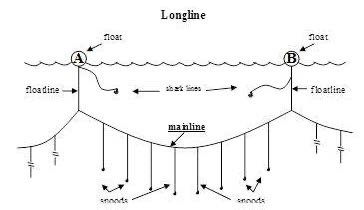
To reduce shark bycatch, do not use branch lines running directly off the longline floats or floatlines, known as shark lines.
Nylon Leaders
It has long been known that the use of metal wire leaders maximizes the retention of hooked sharks. This is because sharks, of course, are unable to cut the wire and escape (Alfonso et al., 2012). For this reason, some countries have banned the use of wire leaders in pelagic longlining and require the use of nylon (monofilament and multifilament) leaders instead.
But another reason to use nylon over wire leaders is that catch rates of bigeye tuna are significantly higher using nylon leaders. Bigeye tuna have good eyesight, so they likely are able to see wire—but not nylon—leaders. Even when factoring in the extra cost of replacing lost hooks and nylon leaders, the financial benefit of the additional bigeye tuna catch makes the use of nylon leaders more profitable than the use of wire leaders (Ward et al., 2007).
Limit Soak Duration
Reducing total soak time could reduce at-vessel mortality rates of all shark species. Increased soak time is related to a decrease in the post-capture survival of sharks in longline fisheries.