Longline Guidebook
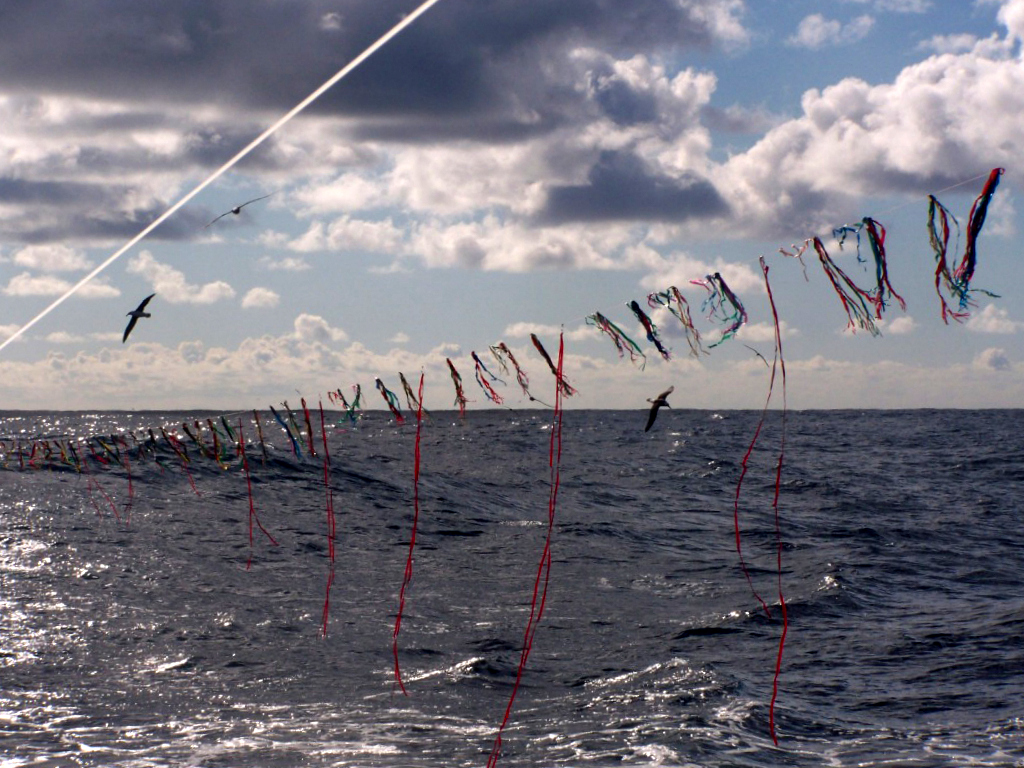
A bird-scaring line (BSL), also known as tori line or bird streamer line, is a line (often 100 meters, or 328.08 feet, long) that is towed from a high point near the stern. On the BSL, brightly colored streamers are suspended at regular intervals to deter birds from reaching the baited hooks and sinking baits, dramatically reducing seabird attacks and bycatch. The streamers flap as the vessel pitches and rolls, and this deters the birds from flying near the stern of the vessel.
Videos about deploying a bird-scaring line are available on YouTube at:
https://www.youtube.com/watch?v=Lt1MAQtKzUU https://www.youtube.com/watch?v=1fr4icCbEaA http://youtu.be/9WG6drHNcrk
Recommendations for Vessels ≥ 35 m (≥ 114.83 Feet) Total Length
The use of two BSLs simultaneously, one on each side of the sinking longline, provides maximum protection from bird attacks under different wind conditions. It is recommended to install BSLs as follows:
- To achieve the minimum recommended aerial extent of 100 m (328.08 feet), they should be attached to the vessel suspended from a point a minimum of 8 m (26.24 feet) above the water at the stern.
- They should contain a mix of brightly colored long and short streamers placed at intervals of no more than 5 m (16.40 feet). Long streamers should be attached to the line with swivels and should reach the sea surface in calm conditions.
- Baited hooks should be deployed within the area bounded by the two BSLs. If large vessels use only one BSL, it should be deployed windward of the sinking baits. If baited hooks are set outboard of the wake, BSL vessel attachment point should be positioned several meters outboard of the side of the vessel where the baits are deployed.
Recommendations for Vessels < 35 m (< 114.83 Feet) Total Length
On these vessels, two BSL designs have proven effective:
- A design with a mix of long and short streamers, with long streamers placed at 5 m (16.40 feet) intervals over at least the first 55 m (180.44 feet) of the BSL
- A design with only short streamers (no less than 1 m (3.28 feet) in length) placed at 1 m (3.28 feet) intervals along the length of the aerial extent
In both cases, streamers should be brightly colored. To achieve a minimum recommended aerial extent of 75 m (246.06 feet), they should be attached to the vessel and suspended from a point a minimum of 8 m (26.24 feet) above the water at the stern.