Commission for the Conservation of Southern Bluefin Tuna
Purse Seine Guidebook
- Table of Contents
- Chapter 1
- Chapter 2
- Chapter 3
- Introduction
- Avoid Bycatch
- Minimize the Risk of Capture
- Reduce Bycatch Mortality
- Offset Unavoidable Bycatch Mortality
- 1. Sharks and Rays
- Sharks and Rays Commonly Encountered
- Reducing Shark and Ray Bycatch
- Target Large Schools
- Attract Sharks Out of the Net
- Fish Sharks in the Net to Release Them
- Modify Fishing Gear
- On Deck Safe Handling and Releasing Techniques
- Manual Handling Do’s
- Handling Medium Sharks
- Handling Stingrays
- Handling and Release with Bycatch Release Devices
- Light Equipment
- Shark Release Ramps with Hopper
- Mobulid Sorting Grids (with Vessel’s Crane)
- Releasing Whale Sharks
- Shark Handling and Release Do’s
- Shark Handling and Release Don’ts
- End Wasteful Shark Finning
- 2. Sea Turtles
- Most Common Bycaught Sea Turtle Species
- 3. Selective Tuna Fishing: Reducing Catch of Small Bigeye & Yellowfin Tuna
- Species Identification
- Yellowfin (30-45 cm)
- Bigeye (30-45cm)
- Yellowfin (46-110cm)
- Bigeye (46-110 cm)
- Yellowfin (>110 cm)
- Bigeye (>110 cm)
- Fisher Cooperation and Input
- Chapter 4
- Introduction
- International Organizations and Instruments
- Inter-American Tropical Tuna Commission
- Western and Central Pacific Fisheries Commission
- International Commission for the Conservation of Atlantic Tunas
- Indian Ocean Tuna Commission
- Commission for the Conservation of Southern Bluefin Tuna
- Further Notes on Data Reporting and Compliance
- Conclusion
- Credits and Citations
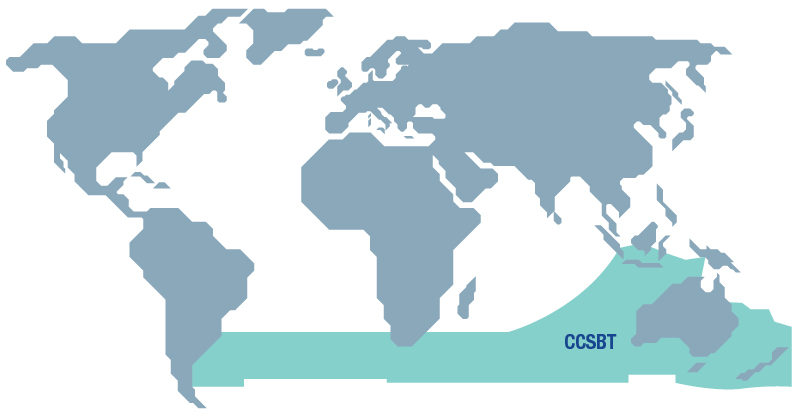
The Commission for the Conservation of Southern Bluefin Tuna was founded in 1994. The Commission has no specific area of jurisdiction. Instead, the Commission applies to southern bluefin tuna (Thunnus maccoyii – SBT) throughout its global distribution. CCSBT is recognized as having the principal SBT management role and therefore conducts the assessments and sets the conservation measures for SBT.
Science planning, execution, and analysis is primarily conducted by the Scientific Committee and Member States. CCSBT shares interest with several other RFMOs, namely WCPFC, IOTC and ICCAT.
CCSBT collects a variety of data types from its members and cooperating non-members, including total catch, catch and effort data, and catch at size data. Catch and trade information is also collected. CCSBT does not have a management area and has no mandate for managing species other than SBT, although the Commission has established a Working Group on Ecologically Related Species (ERSWG) and has taken measures to reduce the impact of SBT fishing on ecologically related species and bycatch.