FAD Guides for Fishers
Purse Seine Guidebook
- Table of Contents
- Chapter 1
- Chapter 2
- Chapter 3
- Introduction
- Avoid Bycatch
- Minimize the Risk of Capture
- Reduce Bycatch Mortality
- Offset Unavoidable Bycatch Mortality
- 1. Sharks and Rays
- Sharks and Rays Commonly Encountered
- Reducing Shark and Ray Bycatch
- Target Large Schools
- Attract Sharks Out of the Net
- Fish Sharks in the Net to Release Them
- Modify Fishing Gear
- On Deck Safe Handling and Releasing Techniques
- Manual Handling Do’s
- Handling Medium Sharks
- Handling Stingrays
- Handling and Release with Bycatch Release Devices
- Light Equipment
- Shark Release Ramps with Hopper
- Mobulid Sorting Grids (with Vessel’s Crane)
- Releasing Whale Sharks
- Shark Handling and Release Do’s
- Shark Handling and Release Don’ts
- End Wasteful Shark Finning
- 2. Sea Turtles
- Most Common Bycaught Sea Turtle Species
- 3. Selective Tuna Fishing: Reducing Catch of Small Bigeye & Yellowfin Tuna
- Species Identification
- Yellowfin (30-45 cm)
- Bigeye (30-45cm)
- Yellowfin (46-110cm)
- Bigeye (46-110 cm)
- Yellowfin (>110 cm)
- Bigeye (>110 cm)
- Fisher Cooperation and Input
- Chapter 4
- Introduction
- International Organizations and Instruments
- Inter-American Tropical Tuna Commission
- Western and Central Pacific Fisheries Commission
- International Commission for the Conservation of Atlantic Tunas
- Indian Ocean Tuna Commission
- Commission for the Conservation of Southern Bluefin Tuna
- Further Notes on Data Reporting and Compliance
- Conclusion
- Credits and Citations
A number of research projects have investigated alternative FAD designs that not only reduce the incidental entanglement and catch of sharks and sea turtles but also are constructed using biodegradable materials, which reduce the impacts of lost and abandoned FADs while maintaining the FAD’s ability to aggregate fish. The “FAD Do’s” and “FAD Don’ts” galleries illustrate the do’s and don’ts of non-entangling and biodegradable FAD design. ISSF also produced a guide summarizing the recommendations on non-entangling and biodegradable FAD construction.
Jelly-FADs
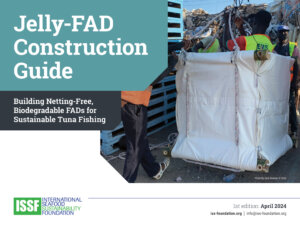
In response to the challenge for fleets of transitioning to FADs made from organic materials, which are in general less durable than plastic-based alternatives currently in use, ISSF has developed the “jelly-FAD” — a new non-entangling and biodegradable FAD design. Inspired by the neutral buoyancy of jellyfish, the jelly-FAD is a lighter, simpler structure than other FAD designs — including previous biodegradable designs — that have been used to attract tuna.
Jelly-FADs are constructed using bamboo, cotton, abacá, and other organic materials. To build jelly-FADs for their vessels, tuna fishers can consult ISSF’s Jelly-FAD Construction Guide.