Inter-American Tropical Tuna Commission
Purse Seine Guidebook
- Table of Contents
- Chapter 1
- Chapter 2
- Chapter 3
- Introduction
- Avoid Bycatch
- Minimize the Risk of Capture
- Reduce Bycatch Mortality
- Offset Unavoidable Bycatch Mortality
- 1. Sharks and Rays
- Sharks and Rays Commonly Encountered
- Reducing Shark and Ray Bycatch
- Target Large Schools
- Attract Sharks Out of the Net
- Fish Sharks in the Net to Release Them
- Modify Fishing Gear
- On Deck Safe Handling and Releasing Techniques
- Manual Handling Do’s
- Handling Medium Sharks
- Handling Stingrays
- Handling and Release with Bycatch Release Devices
- Light Equipment
- Shark Release Ramps with Hopper
- Mobulid Sorting Grids (with Vessel’s Crane)
- Releasing Whale Sharks
- Shark Handling and Release Do’s
- Shark Handling and Release Don’ts
- End Wasteful Shark Finning
- 2. Sea Turtles
- Most Common Bycaught Sea Turtle Species
- 3. Selective Tuna Fishing: Reducing Catch of Small Bigeye & Yellowfin Tuna
- Species Identification
- Yellowfin (30-45 cm)
- Bigeye (30-45cm)
- Yellowfin (46-110cm)
- Bigeye (46-110 cm)
- Yellowfin (>110 cm)
- Bigeye (>110 cm)
- Fisher Cooperation and Input
- Chapter 4
- Introduction
- International Organizations and Instruments
- Inter-American Tropical Tuna Commission
- Western and Central Pacific Fisheries Commission
- International Commission for the Conservation of Atlantic Tunas
- Indian Ocean Tuna Commission
- Commission for the Conservation of Southern Bluefin Tuna
- Further Notes on Data Reporting and Compliance
- Conclusion
- Credits and Citations
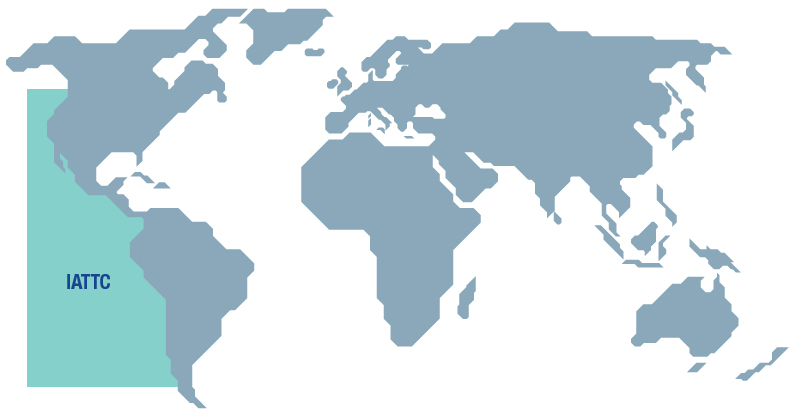
The Inter-American Tropical Tuna Commission (IATTC) area of jurisdiction is the eastern Pacific Ocean. IATTC was founded in 1949, making it the oldest tuna commission in the world. The RFMO is relatively small. Its different working groups usually meet on an annual or biannual basis, although smaller groups meet on an ad-hoc basis as required. The IATTC manages transboundary stocks of temperate tuna in coordination with the International Scientific Committee of Tuna and Tuna-like species in the Northern Pacific Ocean (ISC), while tropical tuna are coordinated with the WCPFC.
The Commission applies the precautionary principle to fisheries management. The Commission interprets Maximum Sustainable Yield (MSY) as a target reference point and thus if catches for target species reach the MSY limit, management measures are sought.
Mandatory fisheries data submitted to the Commission include catch-and-effort data and length frequency data. In addition, the Commission holds information on gear, flag, and fish-carrying capacity for several fisheries. IATTC has an extremely comprehensive observer program covering 100% of large purse-seine vessels, although coverage on longline and small purse-seine vessels is not carried out by the secretariat.