Purse Seine Guidebook
RFMOs and flag states are already taking action to monitor or regulate FAD use — including mandating 100% observer coverage, closing areas to FAD fishing, requiring submission of specific FAD-related data, and developing FAD marking strategies and registers.
FAD data collection and monitoring, including the numbers of FAD deployments and FADs in the water, enable the development of a practical, science-based approach to FAD management as well as a better understanding of FAD impact on both tuna and bycatch stocks, and on the environment.
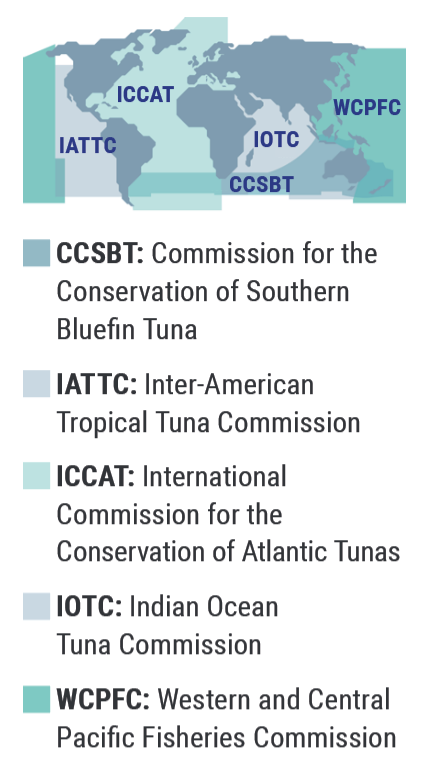
- All four tropical tuna RFMOs have increasingly adopted mandatory requirements for the collection and reporting of specific FAD data by vessel operators. The types of general fishery data required for dFADs include nominal catch and catch-and-effort data by set type (e.g., catch by dFAD set, number of dFAD sets) collected through observers and/or logbooks. In the IATTC and WCPFC, these data are required in set-by-set form, while in the IOTC and ICCAT they are required as aggregated data.
- Similarly, FAD-related fishing activities such as deployments, visits, sets, loss, and retrievals, as well as dFAD structural characteristics (e.g., design and construction materials), must be reported to IATTC and WCPFC on a set-by-set basis through observers and/or log sheets. The IOTC and ICCAT currently require this information to be reported in aggregated form.
In addition, three of the tuna RFMOs require the submission of buoy data related to FAD tracking — including information on buoy inventory and activity (e.g., buoy type, deployment time and position, daily positions and buoy activation and deactivation events), though the formats and requirements vary:
- For example, the IATTC requires the submission of both positional and biomass data from echosounder buoys for all dFADs operated by a vessel.
- The IOTC requires a vessel to submit one position per day of all FADs for compliance purposes, while ICCAT requires the same information in aggregated form.
- Although the WCPFC has not adopted similar FAD reporting requirements, the Parties of Nauru Agreement (PNA) does require buoy position data from vessels operating in PNA Economic Exclusive Zones (EEZs) under the PNA Vessel Day Scheme (VDS).