Purse Seine Guidebook
Sea turtles are sometimes found entangled in FAD nets or associated with the tuna school inside the net during the fishing set. Regarding sea turtles and FAD fishing, the most effective bycatch mitigation measures focus on the structure and/or configuration of the FAD design itself, avoiding the use of nettings, as discussed in the previous chapter.
All sea turtles are protected internationally, as these long-lived animals face numerous environmental threats, such as destruction of nesting grounds, over-harvesting of eggs, boat collisions, ingestion of marine debris, diseases linked to ocean pollution, and interactions with fisheries. There are seven species of sea turtles, five of which are commonly encountered during tuna fishing operations.
Best Release Practices
The best current practice to prevent turtle mortality once the animal is entangled in the purse-seine net is to use speedboats to release the turtle unharmed before it passes through the power block. The best time for this action is when the entangled turtle and net first come out of the water on the way to the power block — at which point hauling should be paused. If needed, use clippers to cut the net. Disentangling the turtle at the earliest possible stage maximizes survival. Speedboats can also be used to remove any free-swimming encircled turtles.
Handling Techniques
When handling turtles, never lift the turtle by the flippers or use sharp tools (e.g., gaffs) to retrieve them. Instead, hold the turtle by the sides of its shell and ease it head-first into the water as soon as possible.
If the turtle appears unconscious (likely due to prolonged entanglement underwater), place the turtle on a tilted surface with its hindquarters about 15 cm (6 in) higher than its head to allow water to drain from its lungs. Keep the turtle moist by covering its body (not the nose or mouth) with a wet towel or by spraying it periodically with water, and maintain a temperature above 15° C (60° F). Do not leave the turtle lying upside down. Check the turtle’s reflexes by gently touching its tail or eyelid every three hours. An unconscious but living turtle may not respond.
If, after 24 hours, the turtle shows no sign of recovery, it is likely dead. If it does recover, release it gently back into the water.
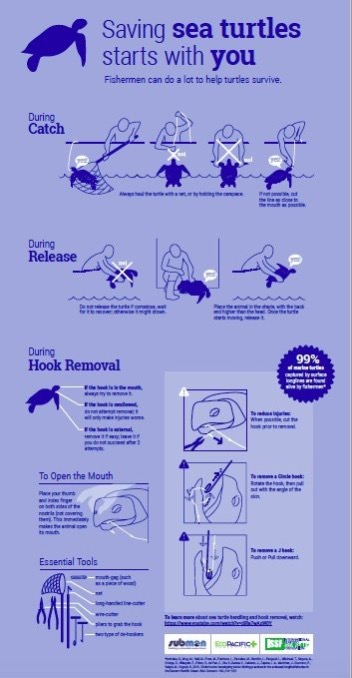
Sea turtle bycatch mitigation techniques. Infographic: ISSF 2016