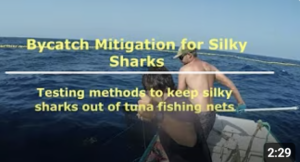
Fish Sharks in the Net to Release Them
Purse Seine Guidebook
- Table of Contents
- Chapter 1
- Chapter 2
- Chapter 3
- Introduction
- Avoid Bycatch
- Minimize the Risk of Capture
- Reduce Bycatch Mortality
- Offset Unavoidable Bycatch Mortality
- 1. Sharks and Rays
- Sharks and Rays Commonly Encountered
- Reducing Shark and Ray Bycatch
- Target Large Schools
- Attract Sharks Out of the Net
- Fish Sharks in the Net to Release Them
- Modify Fishing Gear
- On Deck Safe Handling and Releasing Techniques
- Manual Handling Do’s
- Handling Medium Sharks
- Handling Stingrays
- Handling and Release with Bycatch Release Devices
- Light Equipment
- Shark Release Ramps with Hopper
- Mobulid Sorting Grids (with Vessel’s Crane)
- Releasing Whale Sharks
- Shark Handling and Release Do’s
- Shark Handling and Release Don’ts
- End Wasteful Shark Finning
- 2. Sea Turtles
- Most Common Bycaught Sea Turtle Species
- 3. Selective Tuna Fishing: Reducing Catch of Small Bigeye & Yellowfin Tuna
- Species Identification
- Yellowfin (30-45 cm)
- Bigeye (30-45cm)
- Yellowfin (46-110cm)
- Bigeye (46-110 cm)
- Yellowfin (>110 cm)
- Bigeye (>110 cm)
- Fisher Cooperation and Input
- Chapter 4
- Introduction
- International Organizations and Instruments
- Inter-American Tropical Tuna Commission
- Western and Central Pacific Fisheries Commission
- International Commission for the Conservation of Atlantic Tunas
- Indian Ocean Tuna Commission
- Commission for the Conservation of Southern Bluefin Tuna
- Further Notes on Data Reporting and Compliance
- Conclusion
- Credits and Citations
Fish Sharks in the Net to Release Them
A bycatch release method tested in the Atlantic Ocean, based on skipper suggestions, involved fishing sharks with baited hooks after they were already encircled by the tuna purse-seine net and then releasing them outside the net. In seven sets, 11 silky sharks (21% of those present) were safely caught and released in good condition, and all tagged individual sharks survived.
The process was simple, posed low risk to both the catch and the gear, and was effective for removing sharks from the net without harming them. However, it also has some practical limitations, such as the time required to fish the sharks or the difficulty of applying the method in rough seas.
This technique shows strong potential as a bycatch mitigation tool, although further trials are needed to optimize it for broader use.