Bycatch on FAD Associated Sets
Purse Seine Guidebook
- Table of Contents
- Chapter 1
- Chapter 2
- Chapter 3
- Introduction
- Avoid Bycatch
- Minimize the Risk of Capture
- Reduce Bycatch Mortality
- Offset Unavoidable Bycatch Mortality
- 1. Sharks and Rays
- Sharks and Rays Commonly Encountered
- Reducing Shark and Ray Bycatch
- Target Large Schools
- Attract Sharks Out of the Net
- Fish Sharks in the Net to Release Them
- Modify Fishing Gear
- On Deck Safe Handling and Releasing Techniques
- Manual Handling Do’s
- Handling Medium Sharks
- Handling Stingrays
- Handling and Release with Bycatch Release Devices
- Light Equipment
- Shark Release Ramps with Hopper
- Mobulid Sorting Grids (with Vessel’s Crane)
- Releasing Whale Sharks
- Shark Handling and Release Do’s
- Shark Handling and Release Don’ts
- End Wasteful Shark Finning
- 2. Sea Turtles
- Most Common Bycaught Sea Turtle Species
- 3. Selective Tuna Fishing: Reducing Catch of Small Bigeye & Yellowfin Tuna
- Species Identification
- Yellowfin (30-45 cm)
- Bigeye (30-45cm)
- Yellowfin (46-110cm)
- Bigeye (46-110 cm)
- Yellowfin (>110 cm)
- Bigeye (>110 cm)
- Fisher Cooperation and Input
- Chapter 4
- Introduction
- International Organizations and Instruments
- Inter-American Tropical Tuna Commission
- Western and Central Pacific Fisheries Commission
- International Commission for the Conservation of Atlantic Tunas
- Indian Ocean Tuna Commission
- Commission for the Conservation of Southern Bluefin Tuna
- Further Notes on Data Reporting and Compliance
- Conclusion
- Credits and Citations
There is a greater number and variety of bycatch species in FAD-associated sets than in unassociated sets, including small yellowfin and bigeye tuna, sharks, turtles, billfish, and bony fish. By weight, the primary impact of FAD fishing is largely on non-targeted, small tuna. This represents 5% to 68% of a total bycatch, while it corresponds to between 0.06% and 5% of the total catch.
Other species of fish, sharks, and other marine life are also captured; the bycatch amount of each species can vary widely depending on the region, time of the year, vessel, crew experience, and other factors. Typically, bycatch in associated sets is made up of other fish, sharks, and rays, averaging about 5% of the total catch, ranging from 1.1% to 7.4% depending on the ocean. For comparison, unassociated sets result in less bycatch, ranging on average from 0.3% to 1.8%.
Research is ongoing to investigate additional FAD fishing techniques that can reduce the bycatch attracted to, or the catch associated with, FADs. The current best practices to mitigate FAD-related bycatch will be presented in Chapter 3.
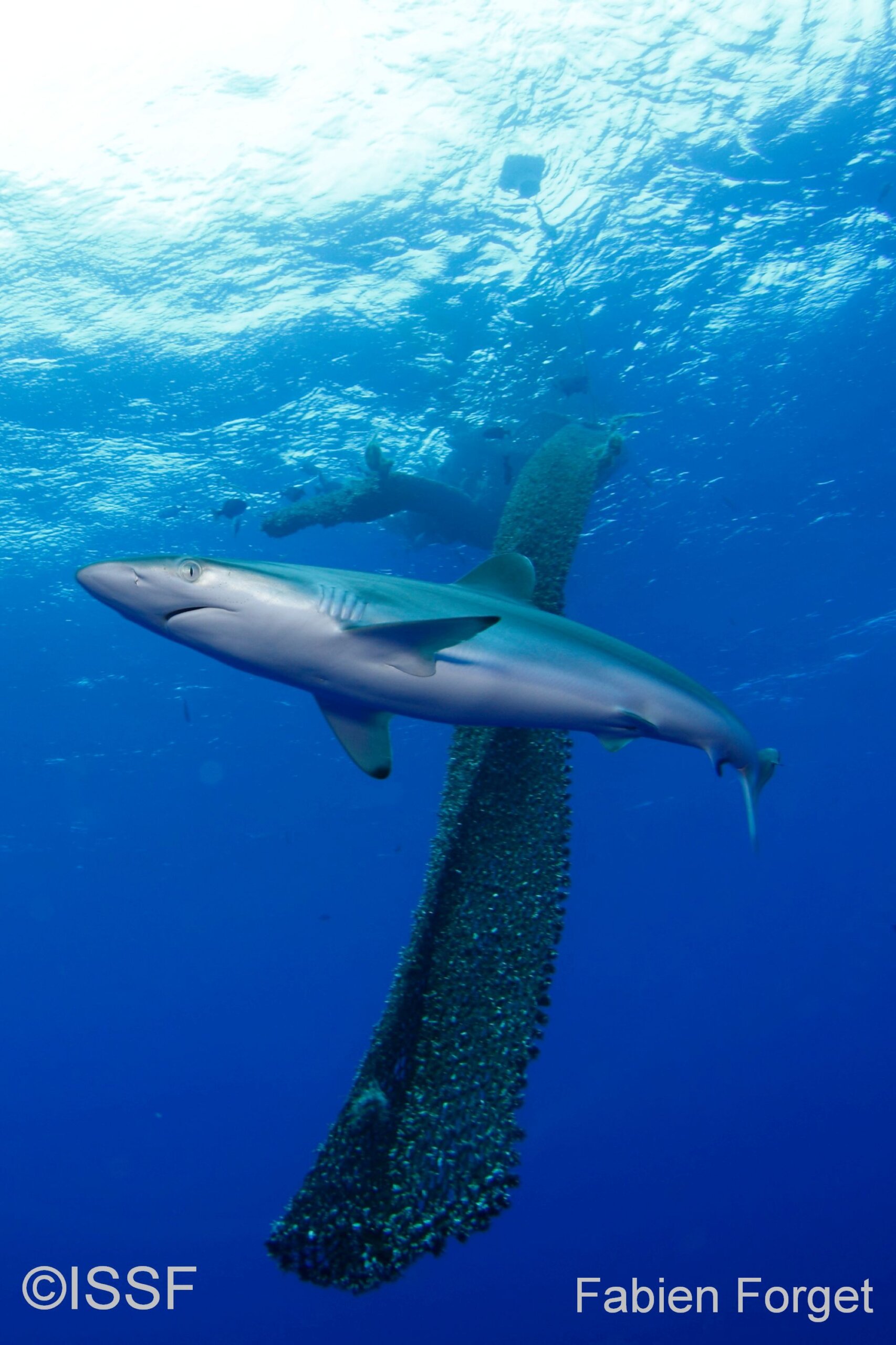
Bycatch underneath a conventional FAD. Photo: Fabien Forget (ISSF)
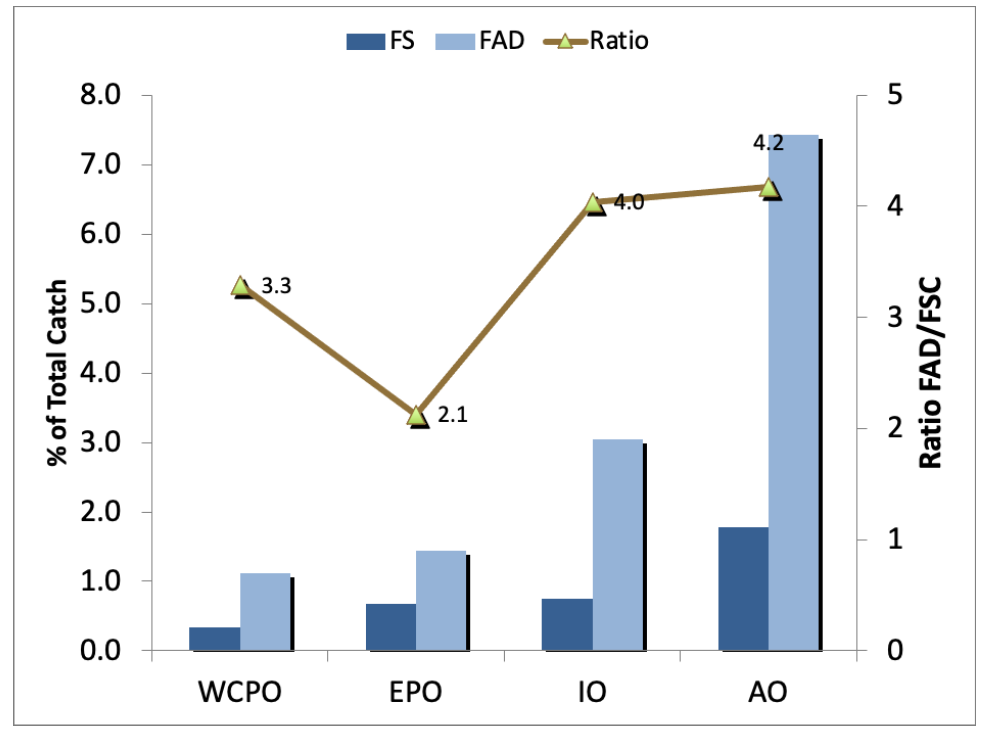
Non-tuna bycatch rates in purse-seine fisheries, as shown in ISSF Technical Report 2021-11
