1. Sharks and Rays
Purse Seine Guidebook
- Table of Contents
- Chapter 1
- Chapter 2
- Chapter 3
- Introduction
- Avoid Bycatch
- Minimize the Risk of Capture
- Reduce Bycatch Mortality
- Offset Unavoidable Bycatch Mortality
- 1. Sharks and Rays
- Sharks and Rays Commonly Encountered
- Reducing Shark and Ray Bycatch
- Target Large Schools
- Attract Sharks Out of the Net
- Fish Sharks in the Net to Release Them
- Modify Fishing Gear
- On Deck Safe Handling and Releasing Techniques
- Manual Handling Do’s
- Handling Medium Sharks
- Handling Stingrays
- Handling and Release with Bycatch Release Devices
- Light Equipment
- Shark Release Ramps with Hopper
- Mobulid Sorting Grids (with Vessel’s Crane)
- Releasing Whale Sharks
- Shark Handling and Release Do’s
- Shark Handling and Release Don’ts
- End Wasteful Shark Finning
- 2. Sea Turtles
- Most Common Bycaught Sea Turtle Species
- 3. Selective Tuna Fishing: Reducing Catch of Small Bigeye & Yellowfin Tuna
- Species Identification
- Yellowfin (30-45 cm)
- Bigeye (30-45cm)
- Yellowfin (46-110cm)
- Bigeye (46-110 cm)
- Yellowfin (>110 cm)
- Bigeye (>110 cm)
- Fisher Cooperation and Input
- Chapter 4
- Introduction
- International Organizations and Instruments
- Inter-American Tropical Tuna Commission
- Western and Central Pacific Fisheries Commission
- International Commission for the Conservation of Atlantic Tunas
- Indian Ocean Tuna Commission
- Commission for the Conservation of Southern Bluefin Tuna
- Further Notes on Data Reporting and Compliance
- Conclusion
- Credits and Citations
While not the most common bycatch in tuna purse seine fishing, sharks and rays are the most vulnerable to its effects. Several aspects of their biology make them highly susceptible to overfishing, including:
- Slow growth rates
- Late maturation
- Long pregnancies
- Low fertility
- Long life spans
It is not true that sharks and, to a lesser extent, rays are hardy and able to withstand rough handling or prolonged exposure and still survive when returned to the sea. In fact, initial studies suggest both sharks and rays have a survivability rate of only 50%, even if they appear healthy upon release. The low survival rate is most probably due to severe stress and/or injury sustained during the fishing and handling process.
This high mortality rate of bycaught sharks and rays is likely influenced by several biological characteristics. Unlike other fish, these animals lack a hard bony skeleton to protect their internal organs. When the animals are out of water, the tissues that hold their organs in place can tear, and the force of gravity can cause organs to become crushed or damaged. This same connective tissue also supports the spinal cord and vertebrae, making sharks and rays especially susceptible to irreversible injury when handled by the head or tail.
Additionally, a shark’s head contains numerous sensitive and fragile organs used for detecting preys. If these are damaged during handling, then the shark – once released— may be unable to locate prey and could starve.
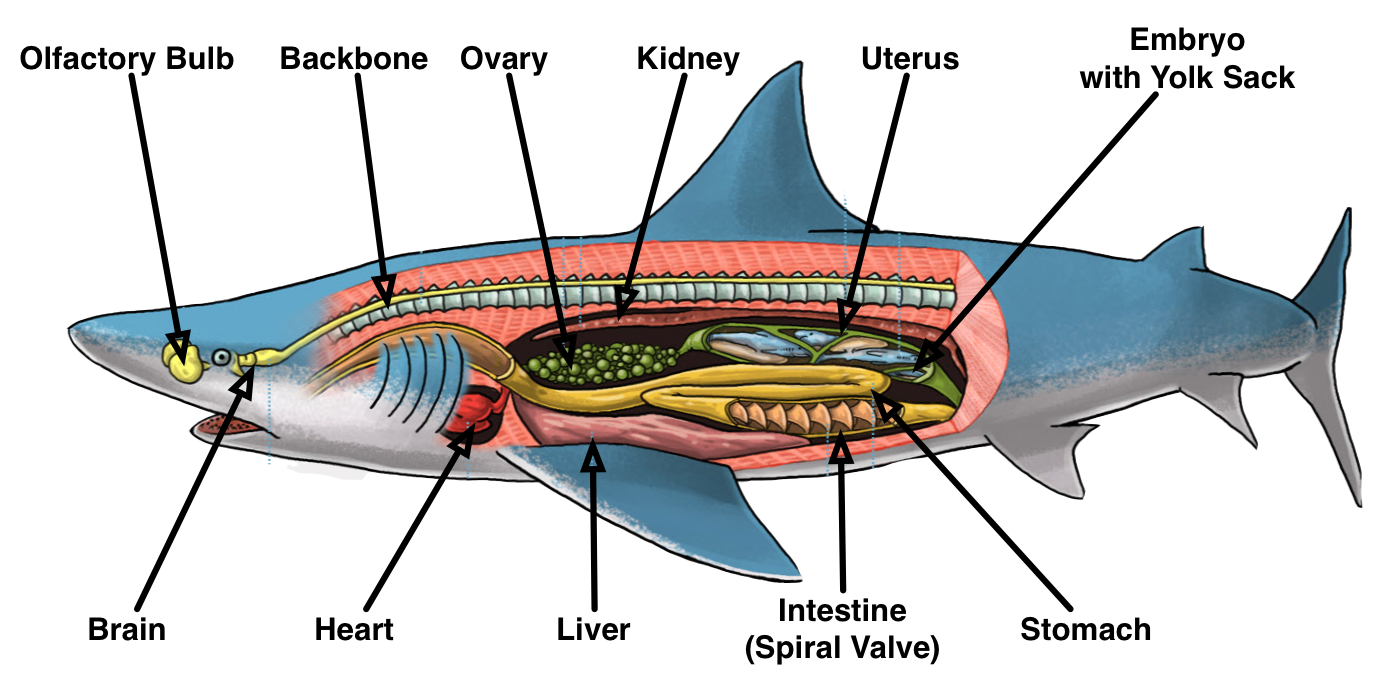
Shark anatomy