Shark Handling and Release Don’ts
Purse Seine Guidebook
- Table of Contents
- Chapter 1
- Chapter 2
- Chapter 3
- Introduction
- Avoid Bycatch
- Minimize the Risk of Capture
- Reduce Bycatch Mortality
- Offset Unavoidable Bycatch Mortality
- 1. Sharks and Rays
- Sharks and Rays Commonly Encountered
- Reducing Shark and Ray Bycatch
- Target Large Schools
- Attract Sharks Out of the Net
- Fish Sharks in the Net to Release Them
- Modify Fishing Gear
- On Deck Safe Handling and Releasing Techniques
- Manual Handling Do’s
- Handling Medium Sharks
- Handling Stingrays
- Handling and Release with Bycatch Release Devices
- Light Equipment
- Shark Release Ramps with Hopper
- Mobulid Sorting Grids (with Vessel’s Crane)
- Releasing Whale Sharks
- Shark Handling and Release Do’s
- Shark Handling and Release Don’ts
- End Wasteful Shark Finning
- 2. Sea Turtles
- Most Common Bycaught Sea Turtle Species
- 3. Selective Tuna Fishing: Reducing Catch of Small Bigeye & Yellowfin Tuna
- Species Identification
- Yellowfin (30-45 cm)
- Bigeye (30-45cm)
- Yellowfin (46-110cm)
- Bigeye (46-110 cm)
- Yellowfin (>110 cm)
- Bigeye (>110 cm)
- Fisher Cooperation and Input
- Chapter 4
- Introduction
- International Organizations and Instruments
- Inter-American Tropical Tuna Commission
- Western and Central Pacific Fisheries Commission
- International Commission for the Conservation of Atlantic Tunas
- Indian Ocean Tuna Commission
- Commission for the Conservation of Southern Bluefin Tuna
- Further Notes on Data Reporting and Compliance
- Conclusion
- Credits and Citations

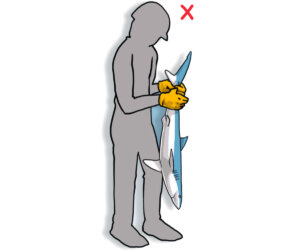
DO NOT lift the animal by its head or tail, as this can severely damage the spinal cord. Illustration: Poisson et al, 2012
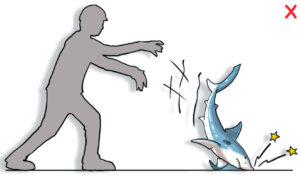
DO NOT throw, hit, or squeeze the animal. Prevent the animal from battering itself against the deck or other hard objects. Illustration: Poisson et al, 2012

DO NOT leave the animal in the sun. If possible, handle the animal in the shade or otherwise reduce its exposure to the sun. Illustration: Updated from Poisson et al, 2012
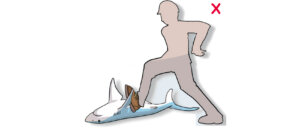
DO NOT yank or push the animal sharply. Illustration: Poisson et al, 2012
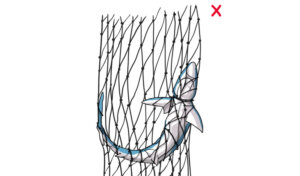
DO NOT tug or yank the net around an entangled animal. Instead use clippers if necessary. For animals entangled in the net, reduce the speed of the net reel. Once the tension is reduced, carefully remove the animal. Illustration: Poisson et al, 2012
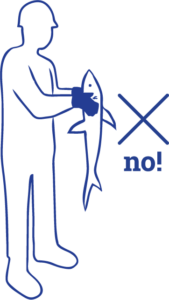
DO NOT insert hands or objects into the gill openings. Illustration: Updated from Poisson et al, 2012
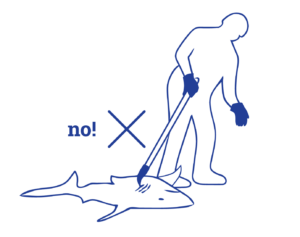
DO NOT insert a gaff, hook, or other pointed object to drag or lift the animal. Illustration: Updated from Poisson et al, 2012