Purse Seine Guidebook
As noted earlier, the catch of small undesired sizes of tunas can account for up to 5% of a FAD set. Reducing the bycatch of small bigeye and yellowfin tunas, which are not target species of a purse seiner, is also a priority for ISSF.
Ongoing bycatch research work is testing various options on board commercial purse seiners to reduce the bycatch of small bigeye and yellowfin. As effective techniques become available, ISSF will update this section of the guidebook.
Acoustic Discrimination of Species
ISSF conducts research to help fishers receive more accurate and reliable information about the species and sizes of tuna swimming around FADs. By using FAD tracking buoys equipped with echosounders, we can move beyond simply estimating the total amount of fish beneath the FAD.
Instead, this technology can give us a clearer picture of which tuna species are present at FADs, even from a distance (“remotely”). With this information, fishers can make more sustainable and selective choices, such as avoiding areas where small undesired sizes or species of tunas are concentrated, especially if those species are protected or under quota limits.
Tuna Acoustic Signals
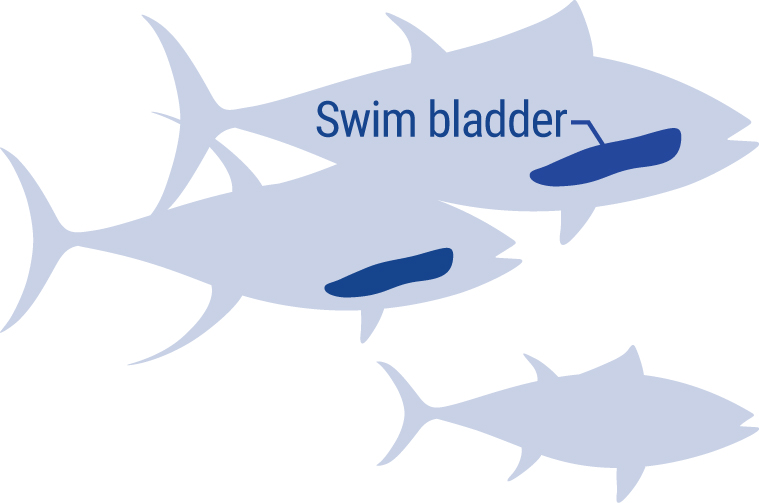
Recent research by ISSF and AZTI has decoded the acoustic signals of tropical tunas. We have learned that different tuna species respond differently to sound due to unique features like swimbladder size and volume, allowing us to identify individual species based on their acoustic “fingerprint.”
For example, bigeye tuna has a large developed swimbladder that helps it regulate buoyancy, and, as a result, its acoustic signal is stronger at lower frequencies. In contrast, skipjack tuna lacks a swimbladder, so its acoustic signal is stronger at higher frequencies. Yellowfin tuna also has a swimbladder, but it is less developed than that of bigeye. Its acoustic response tends to be relatively flat, with values ranging between those of bigeye and skipjack.
By using multiple acoustic frequencies in the echosounder buoys, fishers could be able to better distinguish between tropical tuna species. This might lead to more targeted and responsible fishing. However, for this system to work in practice, two things are needed: First, the new knowledge on acoustic properties of tuna must be built into the buoys already used to track FADs; and second, fishers must receive proper training on how to use this new information.
To support this, ISSF is developing a training program that will be shared in skippers workshops and other dedicated training sessions. Once the training materials are finalized, this section of the guidebook will be updated to reflect the new acoustic discrimination tools and practices.
 ISSF created a visual story on its website to explain the process and benefits of acoustic discrimination for more sustainable tuna fishing.