Western and Central Pacific Fisheries Commission
Purse Seine Guidebook
- Table of Contents
- Chapter 1
- Chapter 2
- Chapter 3
- Introduction
- Avoid Bycatch
- Minimize the Risk of Capture
- Reduce Bycatch Mortality
- Offset Unavoidable Bycatch Mortality
- 1. Sharks and Rays
- Sharks and Rays Commonly Encountered
- Reducing Shark and Ray Bycatch
- Target Large Schools
- Attract Sharks Out of the Net
- Fish Sharks in the Net to Release Them
- Modify Fishing Gear
- On Deck Safe Handling and Releasing Techniques
- Manual Handling Do’s
- Handling Medium Sharks
- Handling Stingrays
- Handling and Release with Bycatch Release Devices
- Light Equipment
- Shark Release Ramps with Hopper
- Mobulid Sorting Grids (with Vessel’s Crane)
- Releasing Whale Sharks
- Shark Handling and Release Do’s
- Shark Handling and Release Don’ts
- End Wasteful Shark Finning
- 2. Sea Turtles
- Most Common Bycaught Sea Turtle Species
- 3. Selective Tuna Fishing: Reducing Catch of Small Bigeye & Yellowfin Tuna
- Species Identification
- Yellowfin (30-45 cm)
- Bigeye (30-45cm)
- Yellowfin (46-110cm)
- Bigeye (46-110 cm)
- Yellowfin (>110 cm)
- Bigeye (>110 cm)
- Fisher Cooperation and Input
- Chapter 4
- Introduction
- International Organizations and Instruments
- Inter-American Tropical Tuna Commission
- Western and Central Pacific Fisheries Commission
- International Commission for the Conservation of Atlantic Tunas
- Indian Ocean Tuna Commission
- Commission for the Conservation of Southern Bluefin Tuna
- Further Notes on Data Reporting and Compliance
- Conclusion
- Credits and Citations
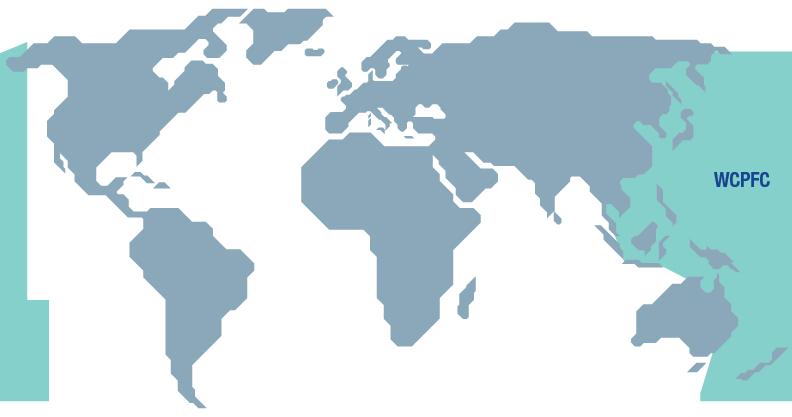
The management of fish resources in the WCPFC area is a complex task due to the diverse interests of coastal states and distant water fishing nations that share highly migratory resources. Effective management rests on the provision of science by two scientific bodies external to the Commission that in turn require timely and accurate provision of data by Commission members. The Ocean Fisheries Programme of the Secretariat of the Pacific Community (SPC-OFP) provides contracted scientific support to the Commission, through the Commission’s Scientific Committee (SC), on tropical and southern stocks.
On the other hand, the International Scientific Committee (ISC) provides non-contracted research to the Commission’s Northern Committee (NC) on stocks occurring north of 20° N. SC and NC provide the scientific outcomes for consideration in the Commission’s annual meeting.
Cooperation with other organizations includes many RFMOs such as IATTC, CCSBT and IOTC.